
Interdisciplinary Research
Interdisciplinary Research
Within the university, interdisciplinary research has been designated as a key institutional performance indicator. To support this objective, several units have been assigned specific responsibilities. The Directorate of Research and Innovation facilitates collaborative research across disciplines, the Directorate of Strategic Studies and Academic Reputation focuses on improving both the quantity and quality of interdisciplinary publications, and the Directorate of Global Connectivity works to expand international research consortia, the Directorate of Cooperation, Communication and Marketing is responsible to generate income from various collaborations, while the International Research Institutes coordinate international research collaborations across multiple research centers.
IPB University evaluates the performance of interdisciplinary research using a set of indicators that form part of its key performance metrics, which are reported through the SIMAKER system.
The success of interdisciplinary research at IPB University is measured through multiple indicators as follows:
(1) the number of competitive interdisciplinary research grants
These grants originate from various sources, including Indonesian government funding, government-to-government matching fund schemes, university funding, and international grants. In 2024, IPB managed more than 700 funded research topics across multiple schemes. Information regarding research topics, principal investigators, and funding sources is available at https://dri.ipb.ac.id/riset-skematik-ipb-yang-dikelola-dri-tahun-2024/. Interdisciplinary projects were supported through several schemes, including BPDPKS, National Competitive Applied Research – PTKN, Pendanaan Riset dan Inovasi untuk Indonesia Maju (RIIM) by BRIN, Action Research, RISPRO LPDP, RKI PTNBH, and UKICIS.
(2) the number of publications.
IPB regularly monitors its publication output, particularly those involving international collaborators and their alignment with the Sustainable Development Goals (SDGs). This monitoring is conducted through both national and institutional platforms, including SINTA, a national database managed by the Ministry of Education, Culture and Higher Education, Scopus, and SciVal. In addition, IPB utilizes internal systems such as SIPPM, which provides information on faculty performance in research and community engagement, and SIPAKARIL, which records individual faculty publication performance.
(3) the number of citations.
Citation data generated from interdisciplinary research collaborations are tracked through Scopus, SciVal, and SINTA, and further analyzed by the Directorate of Strategic Studies and Academic Reputation . IPB also evaluates the sustainability of research collaborations and their geographical distribution through the International Research Network (IRN) Index available on the national platform https://sinta.kemdikbud.go.id/wcu/overview3
(4) the number of new international research consortia.
The Directorate of Global Connectivity manages data related to international research consortia. These records are reported through SIMAKER, an internal system used to monitor institutional achievements. Information on active research consortia can be accessed at https://global.ipb.ac.id/research-consortia/ .
(5) the number of innovations and patents
produced through interdisciplinary research collaboration. Since December 2020, the Ministry of Education, Culture and Higher Education has implemented the Kedaireka Program, a matching fund initiative designed to strengthen collaboration between academia and industry and accelerate the downstreaming of research outputs and innovations. IPB has been actively involved in this program and has received one of the highest numbers of grants. News about Kedaireka-funded initiatives can be accessed at https://www.ipb.ac.id/news/index/2024/07/raih-rp-24-miliar-program-dana-padanan-kedaireka-lkst-ipb-university-bekali-inovator-agar-program-berjalan-clear-and-clean/
(6) The amount income from collaboration
This indicator includes revenue from various forms of domestic and international collaboration in education, research, community service, and business. Funding sources include national and international donor agencies, governments, industry, NGOs, and others. In recent years, IPB’s revenue from foreign research collaborations has continued to increase. Through various international research consortia, IPB’s involvement in interdisciplinary research has grown.
This key performance indicator is attached to the main tasks and functions of several units, namely the International Research Institute, the Directorate of Research and Innovation, the Directorate of Cooperation, Communication and Marketing, and the Directorate of Global Connectivity.
(7), the number of policy recommendations (policy briefs) produced by research teams, including those derived from interdisciplinary science research. In 2022, IPB launched an online platform dedicated to publishing policy briefs developed by its faculty members (https://journal.ipb.ac.id/index.php/agro-maritim/issue/archive). This platform aims to disseminate research-based knowledge to broader audiences and to contribute to evidence-based policy making and societal impact.
Facilities that support interdisciplinary research at IPB include laboratories, field laboratories and stations, teaching factories, and libraries. These facilities are distributed across several campus locations and provide shared laboratory spaces, research equipment and instruments, meeting rooms, and office areas to facilitate collaborative research activities. While some of these facilities are centrally managed by the university, others are administered by individual faculties and research centers.
1. Laboratories

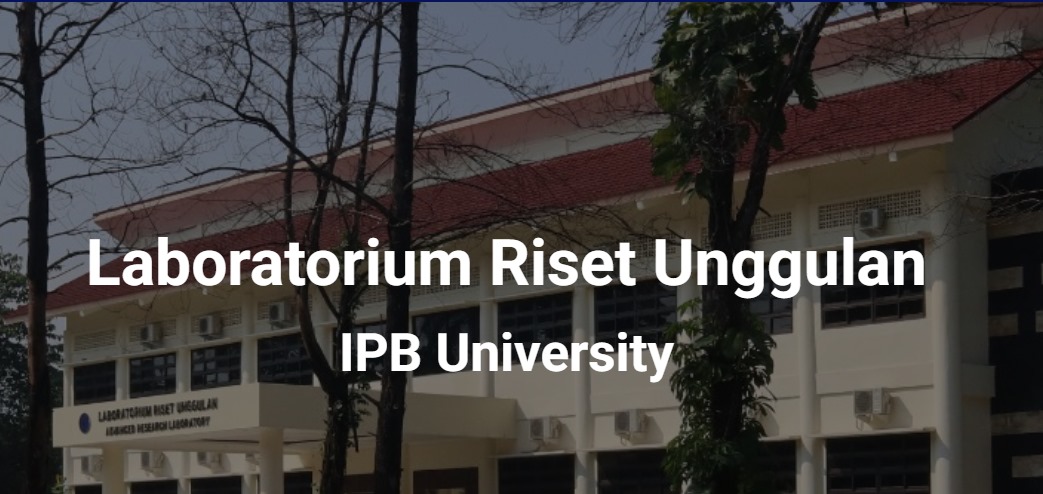
In 2024, IPB received support from KOICA under the project of Capacity Building for the Center for Agriculture and Bioscience of IPB University in Indonesia (KOICA-ICAB) to establish Animal Cell Culture Laboratory and renovation of ARLab. The support from KOICA continues through the establishment of the National Instrumentation Center for Agriculture and Biosciences (NICAB) at IPB, where the groundbreaking of the construction was held in February 2026. The establishment of NICAB will strengthen IPB’s strategic role as the hub for advanced research in the related fields in Indonesia.
Still in 2024, IPB University received a competitive grant from the Ministry of Education, Culture, Research and Technology (Kemdikbudristek) – Republic of Indonesia to establish the Inter-University Center for Excellence for Food Security (Pusat Unggulan Antar Perguruan Tinggi-PUAPT) amounting to 190 billion Rupiah or equivalent to 11.5 Million USD, of which 80 percent of the funds were allocated for laboratory equipment.
b. Integrated laboratory (Laboratorium Terpadu)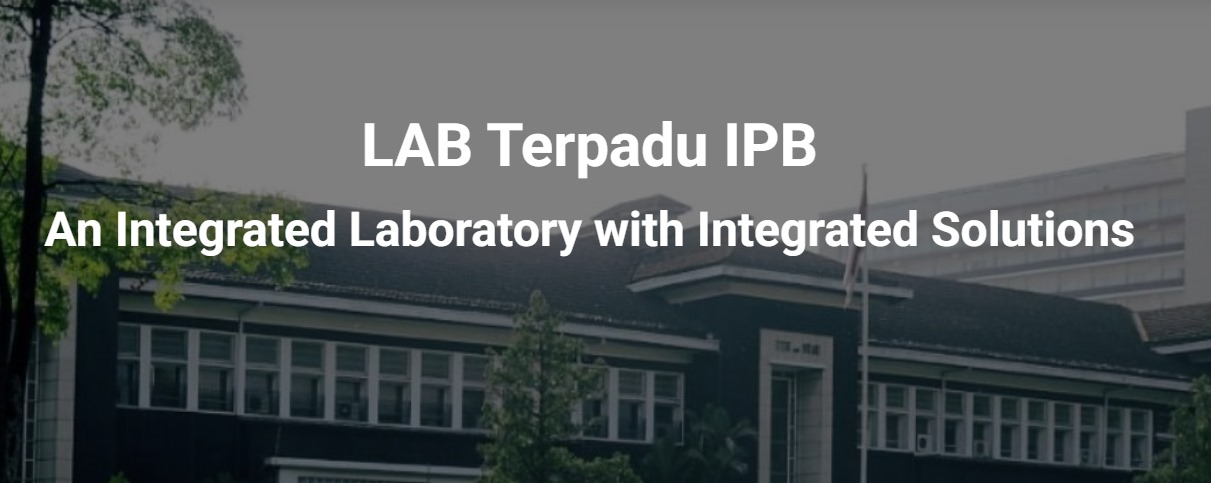
d. Tropical Biopharmaca Research Center (Biofarmaka)
e. Surfactant Bioenergy Research Center (SBRC)
f. Primates Research Center (Pusat Studi Satwa Primata) has several laboratories, including: Microbiology & Immunology Laboratory, pathology laboratory, animal research laboratory, biotechnology laboratory, animal conservation laboratory, breeding laboratory.
g. ProLing Laboratory (Laboratorium Produktivitas dan Lingkungan Perairan)
2. Field Laboratories and Research Station
a. Agriculture and Plantations:
- Pasir Sarongge Garden facilitates research on horticulture production, post-harvest including packaging, marketing as well as agro-tourism.
- Sabisa Farm facilitates research on horticulture and agribusiness
- Agribusiness and Technology Park facilitates research on smart agriculture production, post-harvest and marketing. It is managed by the Directorate of Agromaritime Community Development . It is located next to IPB Darmaga Campus with an area of 6 hectares surrounded by farmers’ settlements and their farming land.
- Cikabayan Farm facilitates research on cash crops and fruit production.
- IPB Jonggol Innovation Valley has been launched in mid of 2024. It is located in Jonggol, about 50 km from Jakarta with an area of 267 hectares. It serves as the center for research and innovation and their applications in the field of crop and animal production and post-harvest, oil palm plantation and crude palm oil production, crop and animal waste production. Info at: https://stp.ipb.ac.id/ipb-university-kembangkan-ipb-jabar-innovation-valley-di-jonggol/
- IPB Plant Clinic
More information on IPB research stations can be accessed here and https://www.ipb.ac.id/page/facilities/station
b. Aquaculture, Marine and Coastal Management :
- Sea Farming in Seribu Island District facilitates research on smart mariculture and marine conservation management.
- Fish Ponds facilitate research on fish production, post-harvest as well as, aquatic health.
- Pelabuhan Ratu Marine Station provides facilities for research on mariculture production.
c. Veterinary, Primate and Biomedicine:
- Tinjil Island facilitates research on primates and biomedicine.
- Biofarmaka Garden is located in IPB main campus in Dramaga
- Veterinary Teaching Hospital. Info available at https://svmbs.ipb.ac.id/veterinary-teaching-hospital/) and https://www.instagram.com/rshpipb/?hl=en.
- The Student Hall of the School of Veterinary Medicine and Biomedical Sciences functions as a collaborative academic space where students, researchers, and faculty members from different disciplines can meet, discuss research ideas, organize seminars, and conduct joint academic activities. This hall supports interdisciplinary interaction by providing a physical venue for workshops, research meetings, and collaborative learning among scholars working in veterinary medicine, biomedical sciences, biotechnology, and related life sciences. Such spaces facilitate the exchange of knowledge and the development of integrated research initiatives.
- IPB BioVet Science serves as a specialized research facility that supports advanced research in veterinary and biomedical sciences. These laboratories enable collaboration among researchers from multiple disciplines, including veterinary medicine, microbiology, biotechnology, public health, and environmental health
Research facilities on animal sciences are located in the IPB Darmaga Campus (10 hectares) and Jonggol Animal Husbandry Education and Research Unit – UP3J (169 hectares). Research facilities include:
- Beef cattle stall
- Dairy cattle stall
- Cattle fattening stall
- Sheep and lamb cage
- Cattle and sheep grazing in Jonggol
- Chicken breeding cage
- Paranje Broiler cage
- Broiler Close House
- Research cages for Poultry, broiler and laying hens
- Omega 3 Production House
- Prospective animals cage
- Milk Processing Unit
- Slaughterhouse
- Compost processing unit
- Maggot production unit
- Agrostology laboratory
- Feed industry laboratory in Jonggol
e. Forestry, Ecotourism and Biodiversity
- Gunung Walat Education Forest is located in Sukabumi with an area of 350 hectares. It facilitates forest management, eco-edu-tourism, as well as carbon pricing. Info at https://www.instagram.com/gunungwalat.ipb/ and https://www.ipb.ac.id/news/index/2025/02/mengenal-hutan-pendidikan-gunung-walat-hpgw-yang-sering-dijadikan-tempat-praktikum-mahasiswa-ipb-university/
- CRC900-BEE in Jambi around 100 ha
- Edy Covariance Climate Tower in Jambi
3. Teaching Factories
- Mini Palm Oil Processing Research Laboratory (Laboratorium Riset Pengolahan Kelapa Sawit Mini)
- Aqua Feed Mill Its facilities are equipped with an extruder to produce floating feed and are designed for various types of aquaculture feed, especially for freshwater fish. For more information, please click here (https://www.ipb.ac.id/news/index/2024/12/ipb-university-resmikan-fasilitas-unggulan-untuk-dukung-pendidikan-penelitian-dan-inovasi/)
- Teaching Feed Industry IPB has a teaching feed industry to support research activities, business development, and strategic programs in the field of food security
- Beverage Pilot Plant and Teaching Industry for product development of Functional Beverage Line, Beverages, Packaged Drinking Water (AMDK)
4. Aquatic Center
It is located at IPB Darmaga Campus (https://g.co/kgs/zYxjYSZ) with an area of 625 meter square. It provides facilities for swimming and diving training as well as aqua robotic experiments.
5. Library
IPB University has a main library that provides access to various scientific literature, databases, and research resources across multiple disciplines. For more information, please click here. The laboratory is also supported with a Co-Creation Lounge Reading Room (https://www.ipb.ac.id/news/index/2024/12/ipb-university-resmikan-fasilitas-unggulan-untuk-dukung-pendidikan-penelitian-dan-inovasi/)
6. Science and Technopark (STP)
IPB University has incubator and innovation hubs where interdisciplinary research teams can incubate new ideas, develop prototypes, launch startup ventures, and promote their research product. Several facilities are developed under IPB STP, namely:
- Start up Center provides co-working spaces and business mentoring for new business entities to become start-ups. Some of the businesses are collaborations between IPB inventors with industry to commercialize and scale up their innovations
- Collaborative Research Center provides office and working space for industrial partners, laboratory space for innovative product development (independently or in collaboration with IPB) and meeting/conference or MICE rooms.
- Pilot Plant and Teaching Industry for product development of Functional Beverage Line, Beverages, Packaged Drinking Water (AMDK)
- Halal Business Incubator Building, which is under construction. This facility will function as a center for innovation and halal product business development. Info available at: (https://www.ipb.ac.id/news/index/2024/12/ipb-university-resmikan-fasilitas-unggulan-untuk-dukung-pendidikan-penelitian-dan-inovasi/)
For more information about IPB STP, please click here (https://stp.ipb.ac.id/).
To enable faculty members and students to access those research facilities, IPB has developed a mobile application named Laboratory Equipment Information System (SOLI Mobile).
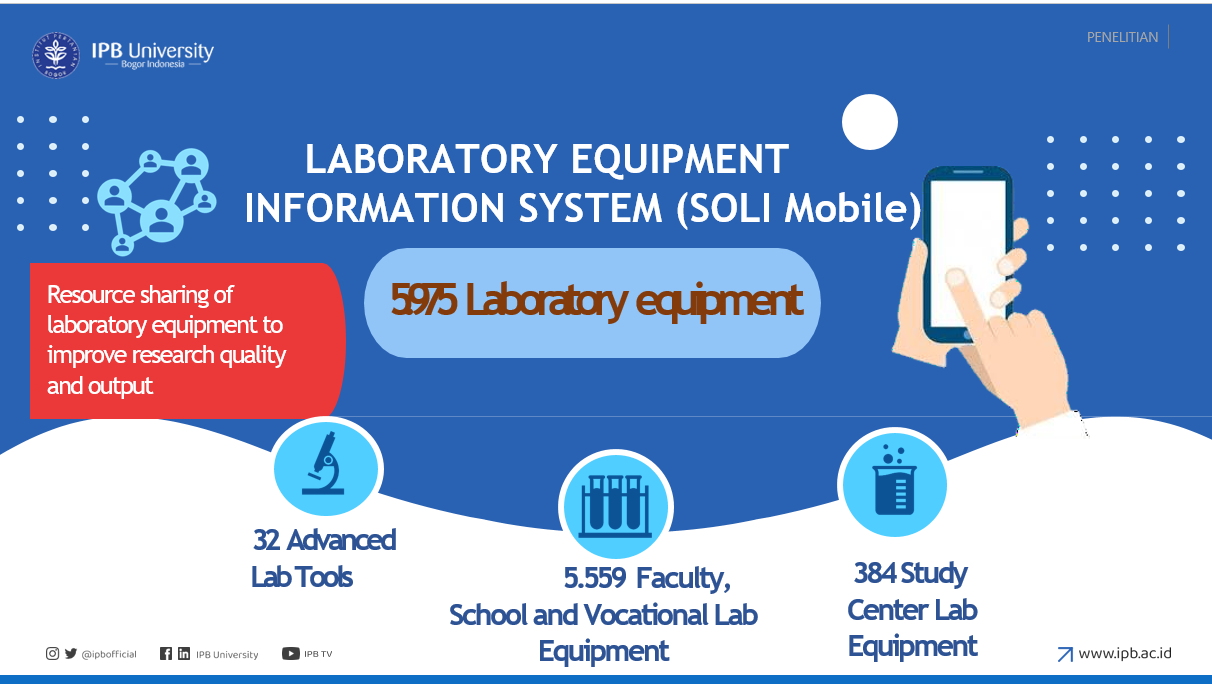
- Podcast Facilities
IPB also has podcast facilities operated by several units at IPB, such as IPB TV and the Center for Transdisciplinary and Sustainability Sciences (CTSS). These podcasts has a strategic role in communicating science to the public. Particularly that of managed by CTSS has facilitated knowledge resulted from interdisciplinary research involving experts from various backgrounds.
Several directorate at IPB are responsible for providing administrative support for interdisciplinary research.
- The Directorate of Research and Innovation organizes information sessions and coaching clinics to assist faculty members in preparing and submitting research proposals. It also provides institutional documents required for grant applications, manages ethical clearance processes, supports reporting procedures, and offers assistance related to financial audits.
- The Directorate of Global Connectivity supports international research collaboration by facilitating ethical clearance arrangements, research permits, and visa processing for international partners conducting joint research with IPB faculty members. The directorate also assists with due diligence documentation and provides support during audits conducted by funding agencies.
- The International Research Institutes provide administrative assistance in contract management and financial processes for international collaborative research projects, while also functioning as interdisciplinary research hubs that connect various research centers within the university.
There are 5 International Research Institutes (IRI) at IPB University in which one of its mandates is to coordinate international research collaborations involving several research centers, including:
- International Research Institute for Maritime, Ocean and Fisheries
- International Research Institute for Advanced Technology
- International Research Institute for Environment and Climate Change
- International Research Institute for Food, Nutrition, and Health
- International Research Institute for Social, Economics and Regional Studies
To enhance interdisciplinary research, IPB provides administrative support for all researchers as well as their partners, including:
- Research and Community Service Information System (SIPPM)
The Research and Community Service Information System (SIPPM) at IPB University is an integrated digital platform designed to support the administration and management of research and community service activities conducted by faculty members and researchers.
SIPPM functions as the main institutional system for recording, managing, and monitoring research-related information. Through this platform, researchers can submit research proposals, report research progress, upload final reports, and document research outputs, including publications, patents, innovations, and community service activities. The system also facilitates the administrative workflow between researchers, research groups, and the Directorate of Research and Innovation, ensuring that all processes follow institutional procedures and documentation standards. By digitalizing the research administration process, SIPPM improves efficiency, transparency, and accountability in research management at IPB University. The platform therefore plays a crucial role in supporting researchers and interdisciplinary research teams by providing a centralized system for research documentation, reporting, and performance monitoring.
- Info session and announcements on research grants
IPB University provides administrative support for interdisciplinary research teams through regular information sessions and announcements on research grants. Each year, the university organizes socialization sessions related to various national and international research funding opportunities. These include grant calls from the Ministry of Higher Education, Science, and Technology, LPDP, BRIN, and other funding agencies.
These sessions aim to inform lecturers and research teams about available funding schemes, proposal requirements, collaboration opportunities, and submission procedures. The announcements and information sessions are disseminated widely through multiple official communication channels to ensure broad access for all academic staff. These channels include the IPB Directorate of Research and Innovation (DRI) website, Instagram, WhatsApp groups, and the HR portal platform used internally by lecturers and researchers.
Examples of recent announcements and socialization activities can be accessed through the following links:
– https://www.instagram.com/p/C89GBVjvvqN/
– https://dri.ipb.ac.id/pengumuman-sosialisasi-penelitian-bpdpks-tahun-2024/
2. Help desk/Pojok Konsultasi Online (POKKI)
Pojok Konsultasi Online (POKKI) is a grant proposal assistance provided by the Directorate of Research and Innovation (DRI) IPB Universities to interdisciplinary research teams in preparing and submitting grant proposals. This could include providing templates, guidelines, and resources for proposal development, as well as offering feedback and editing support to ensure proposals meet funding agency requirements.

3. Providing documents required for research grant proposal and project management
IPB University provides project management support for interdisciplinary research teams through dedicated personnel, including project managers, administrators, and analysts. These roles help coordinate research activities, establish timelines, and monitor progress toward achieving project objectives.
For projects funded by the Indonesia Endowment Fund for Education Agency (Indonesia Endowment Fund for Education Agency/LPDP), a staff member from the Directorate of Research and Innovation (DRI) is specifically assigned as an analyst to support project implementation and oversight.
4. Contract service
The Directorate of Research and Innovation provides a help desk for contract arrangement.
- https://dri.ipb.ac.id/pengumuman-penetapan-penerima-pendanaan-program-riset-kolaborasi-indonesia-ta-2024/
In addition, the International Research Institute also facilitates contract arrangement for international research collaboration.
5. Ethical clearance and research permit
IPB has long established an animal ethics commission and a research ethics committee involving human subjects, which have the task of conducting ethical reviews and providing ethical permits related to the above aspects within the scope of research at IPB. The Directorate of Research and Innovation provides administrative support to help interdisciplinary research teams navigate the ethics approval process and ensure compliance with regulatory requirements. Procedures of ethical clearance are as follows:
- Ethical clearance for research using animal https://dri.ipb.ac.id/download/komisi-etik-hewan/
- Ethical clearance for research using human subjects https://dri.ipb.ac.id/komisi-etik-manusia/
For international cooperation, ethical clearance and research permit must be processed through BRIN. The Directorate of Global Connectivity provides assistance for international partners to process ethical clearance. Information available at https://global.ipb.ac.id/permits/#1743856966341-7357e828-0850
6. Visa Application
The Directorate of Global Connectivity provides assistance for visa applications. Information available at https://global.ipb.ac.id/permits/#1743856976290-87b8d1c3-b2bb
7. Assistance in filling due diligent
Some funding from international agencies required due diligence to ensure the eligibility of an institution to manage research funds in an accountable manner. The Directorate of Global Connectivity provides necessary data and information as well as assistance for researchers to complete this requirement.
8. Help desk for financial aspect (FIRDA dan OSHIN)
In addition to information sessions on research grants, IPB University also provides administrative support through a financial help desk service for researchers. This support is delivered both online and offline to assist research teams in managing the financial aspects of research projects.
IPB regularly organizes financial administration workshops and help desk sessions involving experts and administrative staff from the Directorate of Finance, the Directorate of Research and Innovation (DRI), and the Internal Audit Office. These sessions are designed to guide researchers in understanding and complying with institutional financial procedures and government regulations related to research funding.
The workshops and consultations provide detailed explanations on topics such as financial reporting procedures, internal financial regulations, taxation requirements, eligible and ineligible expenditures, procurement rules, and documentation requirements for research grants. Researchers are also given the opportunity to ask questions and receive direct assistance in preparing and managing their financial reports.
Through these help desk services, IPB University ensures that research teams receive adequate administrative guidance to manage research funds transparently, efficiently, and in accordance with institutional and national financial regulations.
9. Assistance with Material Transfer Agreements (MTA) and import permits for research equipment
10. Information and Help Desk for reporting, monitoring and evaluation. Info available at: https://dri.ipb.ac.id/pengumuman-monitoring-dan-evaluasi-internal-laporan-kemajuan-penelitian-pendanaan-kemendikbudristek-tahun-2023/
11. Assistance for financial audit
The Directorate of Research and Innovation provide guidance for the researcher in spending the budget in accountable manner to ensure the audit process runs well with good assessment
12. Publication Services
For more information regarding publication services, please contact the Directorate of Strategy and Academic Reputation Studies.
Workshops to support publication in 2024:
- Workshops to support publication in 2024:
- Workshop Leveraging AI in Academic Writing
- Pelatihan Penulisan Artikel Populer
As a public university, IPB University implements the tenure and career promotion system established by the Indonesian government. All lecturers are required to perform the Tri Dharma of Higher Education, which represents the national mandate for higher education institutions in Indonesia. The Tri Dharma consists of three main responsibilities: teaching, research, and community service. Accordingly, these three components are reflected in the academic promotion system. Research constitutes a minimum of 40 percent of the total credit points required for promotion. Academic career stages include prospective lecturer (calon dosen), assistant professor (asisten ahli and lektor), associate professor (lektor kepala), and full professor, with each level requiring a specific number of accumulated credit points.
Research is a key component in the academic career system, and credit points are largely assessed based on scientific publications resulting from research activities. The evaluation of these credit points follows the Operational Guidelines for Credit Point Assessment for the Promotion of Lecturer Academic Rank/Position issued by the Ministry of Research, Technology, and Higher Education. These guidelines were recently updated through the Decree of the Minister of Education, Culture, Research, and Technology No. 209 of 2024, which provides technical instructions for the implementation of professional development and career advancement services for lecturers.
The credit score for scientific publications is determined by the quality and reputation of the journals in which the articles are published. Publications in internationally reputable journals with higher impact factors receive greater credit scores. In this context, interdisciplinary research—particularly those conducted through international research collaborations—has a strong potential to be published in high-impact journals, thereby contributing significantly to the credit points required for academic promotion. Furthermore, promotion to the rank of full professor requires evidence of leadership in research projects funded through competitive grant schemes.
IPB has set up several indicators to assess individual performances, and their career development are monitored through internal systems, namely HR Portal, System Information for Scientific Work Assessment (SIPAKARIL) and Information System for Research and Community Development (SIPPM) . These systems are linked to the national platform SISTER.
To further support academic career advancement, IPB University has introduced several initiatives that recognize and encourage interdisciplinary research.
- Promoting the establishment of national and international research consortia;
- Showcasing innovations resulting from interdisciplinary research through the university’s website, innovation gallery, and various exhibitions organized or participated in by IPB;
- Providing incentives for publications and citations, particularly for academic staff publishing in multidisciplinary journals;
- Offering affirmative research grants for research groups. In addition, IPB encourages the formation of research groups that bring together scholars from different disciplines, such as BRAIN (Blockchain, Robotics, and Artificial Intelligence Network), which focuses on emerging technologies through interdisciplinary collaboration.
- Giving awards to the most productive departments/faculties and outstanding lecturers, especially those who have produced research and innovation from interdisciplinary work.
Additional information:
Several government regulations that govern the promotion and functional positions of lecturers:
