IPB University and Nanjing Agricultural University Develop Joint AI-Laboratory for Smart Rice Farming
IPB University and Nanjing Agricultural University Develop Joint AI-Laboratory for Smart Rice Farming
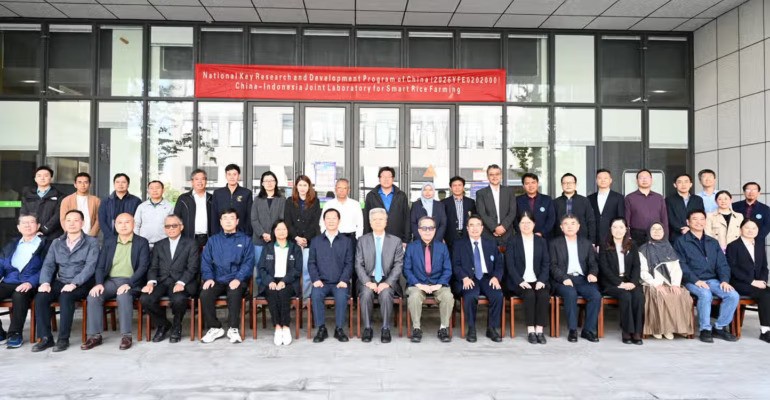
November 10th 2026 – IPB University and Nanjing Agricultural University (NAU) in China are developing an artificial intelligence (AI) based rice growth model and simulation tool.
The platform is designed to be open-source and open-access, useful for predicting rice plant growth. This development is part of the China-Indonesia Joint Laboratory for Smart Rice Farming, which officially began with a kick-off event at NAU on October 30, 2026.
This collaboration is part of the “Belt and Road” AI Joint Laboratory Program, an initiative of China’s Ministry of Science and Technology (MOST) to promote AI research and development collaboration between China and Belt and Road partner countries, under the framework of Industrial Intelligentization in Key Scenarios.
IPB University’s Vice Rector for Research, Innovation, and Agromaritime Development, Prof Ernan Rustiadi, explained the collaboration’s primary mission.
“One of the main missions of this collaboration is to develop rice growth models and simulation tools by integrating mechanistic plant models with AI and big data technologies. This integration is expected to produce models that can be generalized for various agroecosystem conditions,” he said.
In this collaboration, rice farming is the primary focus, given that rice is a vital food commodity for China and ASEAN countries. The program is expected to address a number of challenges, such as climate change, limited natural resources, the efficient use of water and production inputs, as well as the need to increase productivity and food security.
“With the support of this data and these models, smart agricultural technology is expected to improve the accuracy of decision-making in farm management and rice production systems,” added Prof Ernan.
Three Years, Three Components
Meanwhile, the Vice Rector for Global Connectivity, Cooperation, and Alumni at IPB University noted that this project will run for three years (2026–2028), with the goal of developing a comprehensive package of rice growth models and a simulation platform that will be validated and demonstrated in China and Indonesia.
The implementation encompasses three components:
• Demonstration: agricultural demonstrations, field testing of technologies, and the development of a database as the foundation for model development and validation.
• Innovation: the development of AI-based models, algorithms, and tools for predicting and simulating rice growth.
• Communication: human resource (HR) capacity building involving students, young researchers, and experts, as well as scientific meetings, seminars, and the dissemination of research results.
“This collaboration represents a strategic opportunity to enhance Indonesia’s contribution to international science and technology cooperation. Indonesia’s involvement as a demonstration site provides an opportunity to develop and test innovations tailored to farmers’ needs and the characteristics of the national rice production system,” he said.
Targeted outcomes include publications in reputable international journals, smart agriculture models and tools, as well as exchanges of students, faculty, and researchers between IPB University and NAU. The results are also expected to serve as the basis for policy recommendations on the digital transformation of the agricultural sector.
“We are striving to build a productive and sustainable model of science and technology collaboration as a tangible contribution to accelerating the digital transformation of agriculture, strengthening food security, and promoting agricultural innovations that benefit Indonesia and the Global South,” he added. (*/Rz) (IAAS/LAN)
SOURCE: IPB TODAY (https://www.ipb.ac.id/news/index/2026/11/ipb-university-and-nanjing-agricultural-university-develop-joint-ai-laboratory-for-smart-rice-farming/)